Why Your Baby Stares at You (and What It Means)
Those long, unblinking gazes are your baby's brain doing some of its most important wiring.

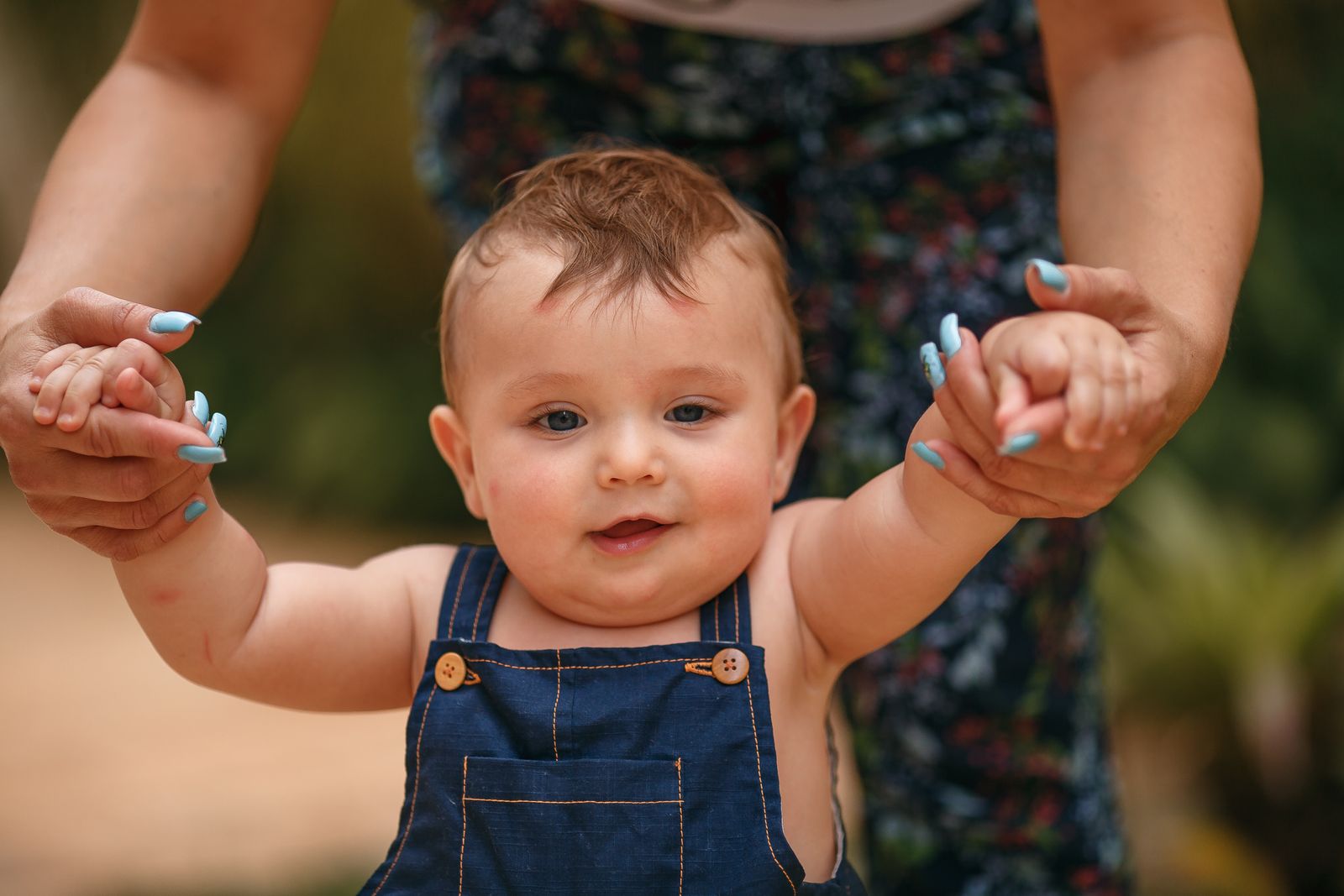
New parents often notice it in the quiet moments: a baby staring at their face with an intensity that can feel almost uncanny. It isn't random. From the earliest days, babies are drawn to faces more than any other visual pattern, and that preference is doing real work.
Faces are the first curriculum
A newborn's vision is blurry and reaches only about 8–12 inches, almost exactly the distance to a parent's face during a feed. In that narrow window, faces are the clearest, most interesting thing in the world. Looking at you is how a baby practices focusing, tracking, and reading emotion.
When your baby stares at you, they're not zoning out. They're studying.
What they're learning
- How to focus and track, your face is the practice field.
- How emotion maps, they mirror your smile before they can make their own.
- That looking leads to a response, the roots of connection.
- That you are a person, separate and reliable, who comes back.
The next time your baby holds your gaze, hold it back. Your baby is studying you more closely than anyone else ever will.
The still-face, and what it reveals
One of the most famous experiments in developmental psychology is the 'still-face' procedure: a parent interacts normally with their baby, then briefly goes completely expressionless, then resumes. Even very young infants react to the still face with escalating distress, reaching, protesting, and eventually turning away. The experiment is often read as a demonstration of how much babies rely on the back-and-forth, but its more useful reading for parents is about repair.
Babies do not need a perfectly responsive caregiver; they need a reliably repairing one. Every interaction has small mismatches (a missed cue, a delayed response), and the research on attachment finds that it is the repair, not the absence of rupture, that builds trust. The still-face experiment shows the rupture; real life is full of repairs, and the repairs are what teach a baby that a connection can break and come back. That is a far more attainable standard than flawless attunement, and it is the one the science actually supports.
- The still-face experiment shows how much babies rely on the back-and-forth.
- Perfect attunement is not the standard; reliable repair is.
- Every day has small ruptures, the repair is what builds trust.
- A connection that breaks and returns teaches the deepest security of all.
References & further reading
Sources cited in this article. We link to peer-reviewed research and reputable guidance wherever possible.
- 1.
Johnson, M. H., et al. (1991). Newborns' preferential tracking of face-like stimuli and its subsequent decline. Psychological Science, 2(2), 132–135.
- 2.
Meltzoff, A. N., & Moore, M. K. (1977). Imitation of facial and manual gestures by human neonates. Science, 198(4312), 75–78.
- 3.
Murray, L., & Trevarthen, C. (1985). Emotional regulation of interactions between two-month-olds and their mothers. Social Perception in Infants.
- 4.
Tronick, E. Z. (1989). Emotions and emotional communication in infants. American Psychologist, 44(2), 112–119.
Written by
MudLittle Contributor
MudLittle, LLC contributor