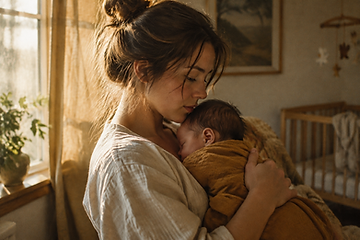
Skin-to-Skin Contact: A Simple Act With Measurable Effects
Holding a naked baby against your bare chest seems too simple to matter. The evidence says it matters enormously.
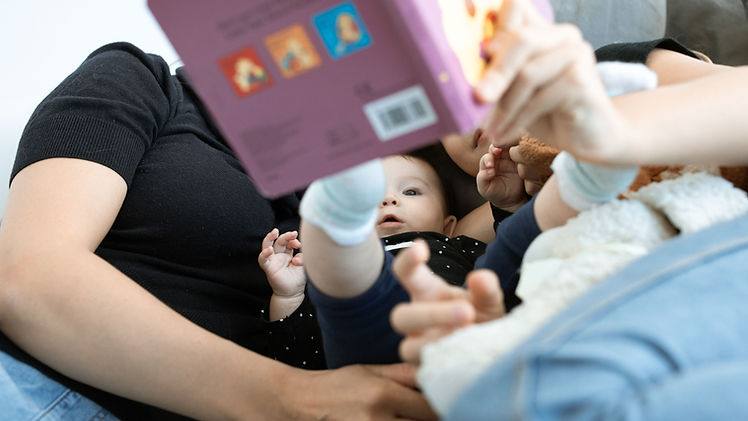
Skin-to-skin contact, sometimes called kangaroo care, is one of the most studied, most effective, and least expensive interventions in all of neonatal care. The Cochrane reviews, which synthesize the highest-quality trials, find consistent benefits across heart rate, breathing, temperature stability, and early breastfeeding success.
Why it works
Your chest is a thermostat, a heartbeat, and a familiar smell, exactly the signals a newborn is wired to find.
A newborn spent nine months in a warm, rhythmic, muffled environment. A parent's bare chest recreates the most important parts of it: warmth that adjusts to the baby's temperature, the sound of a familiar heartbeat, the smell of milk and skin. The baby's nervous system, still learning to regulate, borrows that stability.

The benefit runs both ways
One of the quieter findings is that skin-to-skin lowers parental stress hormones too. Oxytocin rises in both partners in the dyad; cortisol falls. For a parent recovering from birth, that lower cortisol is part of the treatment.
- It stabilizes heart rate, breathing, and temperature.
- It supports early breastfeeding and milk supply.
- It lowers parental stress hormones, too, the benefit runs both ways.
- Any caregiver can do it.
The first hour, and why it's called golden
The first hour after birth is often called the 'golden hour' for a reason: a newborn placed skin-to-skin in that window passes through a predictable sequence of behaviors (from rest, to small movements, to crawling toward the chest, to a first feed) that the research describes as a distinct, biologically programmed stage. Babies who go through it in contact with a parent show more stable temperatures, better early breastfeeding, and measurably less distress than those who are separated for routine procedures that can safely wait.
None of this means that a birth that does not allow for the golden hour (a complication, a needed intervention, an adoption, a separation) is a lost cause. The benefits of skin-to-skin are not confined to the first hour; they accumulate across the early weeks and months, and a chest-to-chest hour on day three or day thirty is still doing the work. The golden hour is the best-studied window, not the only one, and the practice is forgiving by design.
- The first hour is a biologically programmed stage of rest, crawl, and first feed.
- Skin-to-skin in that window stabilizes temperature and supports early feeding.
- The benefits keep accumulating for weeks and months after that first hour.
- A birth that required separation is not a lost chance; later contact still works.
You don't need a special occasion. A quiet hour, a bare chest, and a diaper-only baby is the whole practice, and one of the best-supported things you can do in the early days.
References & further reading
Sources cited in this article. We link to peer-reviewed research and reputable guidance wherever possible.
- 1.
Conde-Agudelo, A., & Díaz-Rossello, J. L. (2016). Kangaroo mother care to reduce morbidity and mortality in low birthweight infants. Cochrane Database of Systematic Reviews, (8), CD002771.
- 2.
Moore, E. R., Anderson, G. C., Bergman, N., & Dowswell, T. (2016). Early skin-to-skin contact for mothers and their healthy newborn infants. Cochrane Database of Systematic Reviews, (11), CD003519.
- 3.
Feldman, R., Rosenthal, Z., & Eidelman, A. I. (2014). Maternal-preterm skin-to-skin contact enhances child physiologic organization and cognitive control across the first 10 years of life. Biological Psychiatry, 75(1), 56–64.
- 4.
Widström, A. M., et al. (2019). Skin-to-skin contact in the first hour after birth. Newborn and Infant Nursing Reviews.
Written by
MudLittle Contributor
MudLittle, LLC contributor