Reading to Babies: The Word Gap, Explained
The '30 million word gap' became one of the most cited statistics in education. The real story is more interesting, and more hopeful.

The famous claim was that children from talkative households hear tens of millions more words in their first years than children from quieter ones. The number has been challenged, the original study was small, and later replications found a smaller gap, but the underlying pattern holds: language exposure in the early years shapes language for life.
Why word counts mislead
What the more careful studies found is that the quality of language matters as much as the quantity. The most predictive factor wasn't how many words a child heard, but how many conversational turns they took, the back-and-forth where an adult responds to a baby's sound as if it were a sentence, and the baby responds back.
The goal isn't volume. It's the back-and-forth, the conversation, not the lecture.
This is hopeful news, because conversational turns are free. They happen in the car, in the bath, at the grocery store. You don't need a curriculum; you need a willingness to treat a babble as a sentence and leave a beat for the reply.
Books as a shortcut
Books are a shortcut to richer language, but the real engine is the dialogue around them. Reading the same book for the hundredth time is exactly how children build the predictive knowledge that makes decoding possible later. Repetition is the point.
- Respond to your baby's babbles as if they were sentences.
- Narrate the ordinary: 'I'm cutting the apple. The apple is red.'
- Read the same book a hundred times if they want it. Repetition is how they learn.
- Pause and let them fill in the end of a familiar line.

The dialogic reading difference
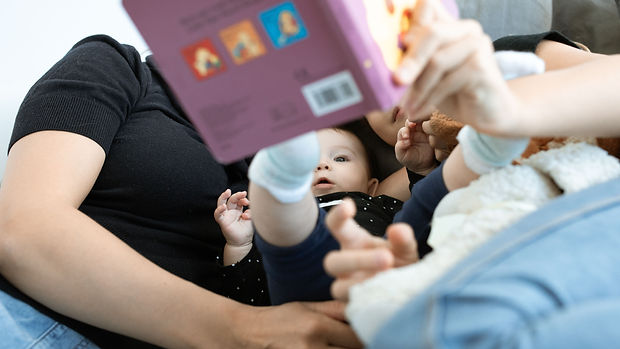
The research on reading to young children has a specific name for the version that works best: dialogic reading, which simply means the adult prompts, expands, and lets the child do more of the talking rather than reciting the text straight through. In trials, dialogic reading produces noticeably larger gains in language than the same books read the ordinary way, not because the books are different, but because the conversation around them is.
The practical version is almost embarrassingly simple. Instead of reading every word, you stop and ask: 'What's that?' and wait. You expand whatever the child says, they say 'dog,' you say 'Yes, a big brown dog, and he's running.' You let them turn the page and choose what to linger on. The book becomes a prompt for a conversation rather than a performance, and the conversation is where the language grows. This works from the first year, with picture books, long before there is a story to read.
- Dialogic reading, prompting and expanding, beats reciting the text.
- Ask 'What's that?' and wait; the pause is where their word goes.
- Expand their words: they say 'dog,' you say 'a big brown dog, running.'
- Let them turn the page and choose what to linger on.

The word gap, reframed, is not a deficit to measure but a set of small, repeatable habits to build, and books are simply the most reliable on-ramp to them.
References & further reading
Sources cited in this article. We link to peer-reviewed research and reputable guidance wherever possible.
- 1.
Hart, B., & Risley, T. R. (1995). Meaningful differences in the everyday experience of young American children. Paul H. Brookes Publishing.
- 2.
Romeo, R. R., Leonard, J. A., Robinson, S. T., et al. (2018). Beyond the 30-million-word gap: children's conversational exposure is associated with language-related brain function. Psychological Science, 29(5), 700–710.
- 3.
Dickinson, D. K., & Tabors, P. O. (2001). Beginning literacy with language: young children learning at home and school. Brookes Publishing.
- 4.
Whitehurst, G. J., et al. (1988). Accelerating language development through picture book reading. Developmental Psychology, 24(4), 552–559.
Written by
MudLittle Contributor
MudLittle, LLC contributor